
Communicating the
Gynecologic Brachytherapy Experience
The Challenge.
Communication Design
〰️
Journey Mapping
〰️
Healthcare
〰️
Communication Design 〰️ Journey Mapping 〰️ Healthcare 〰️
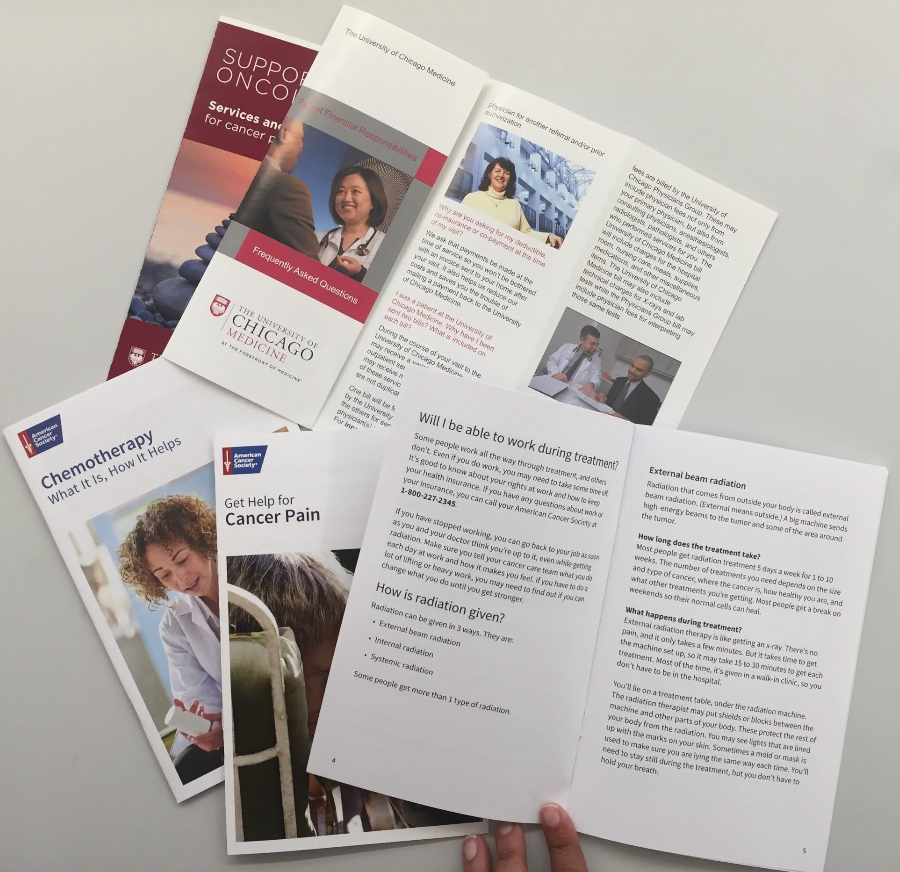
Patients undergoing gynecologic brachytherapy often face a highly complex, emotionally charged treatment journey. Patients often described the process as a "black box," struggled to understand treatment steps, and experienced significant anxiety before, during, and after treatment. Existing educational materials were text-heavy, difficult to understand, poorly personalized, and did little to prepare patients for what they would experience.
The goal of this project was to improve the patient experience by creating a visual discussion guide that could help clinicians explain treatment, reduce anxiety, set expectations, and facilitate meaningful conversations between patients and care teams.
Methodologies &
My Role.
01
Research Planning
Designed interview protocols, stakeholder activities, discussion guides, synthesis processes, and research logistics for a multi-phase healthcare research study.
02
Contextual Research
Conducted 17 stakeholder interviews across patients, caregivers, clinicians, radiation oncologists, therapists, and patient support staff, alongside treatment observations and site visits.
03
Journey Mapping & Service Design
Mapped three brachytherapy treatment pathways, documenting patient activities, stakeholders, locations, information needs, emotional highs and lows, communication gaps, and moments of uncertainty throughout care.
04
Behavioral Synthesis
Transcribed, coded, and synthesized qualitative data using the Quad A and Multi-Level Requirements Frameworks, translating patient, caregiver, and clinician perspectives into actionable design requirements.
05
Communication Design
Designed and iterated three pathway-specific visual discussion guides, collaborating closely with physicians to balance health literacy, clinical accuracy, production feasibility, and patient needs.
Phase 3: Designing & Validating a Clinical Communication Tool
Research findings were translated into a series of visual discussion guides through multiple rounds of concept development and clinician feedback. The team evaluated different narrative structures, illustrations, information hierarchies, physical formats, reading levels, and production constraints while balancing clinical accuracy with accessibility. Rather than producing a single generic document, the final solution consisted of three pathway-specific discussion guides, each tailored to a different treatment pathway and calibrated to a distinct reading level (4.6, 6.2, and 7.0 grade level).
Outcomes
Delivered an NIH reading-level compliant clinical communication tool that improved patient comprehension by approximately 25%, produced three treatment-specific discussion guides and three patient journey maps, and ultimately contributed to a peer-reviewed publication in PubMed.
This work used behavioral research to redefine the problem and map a complex healthcare service. Rather than stopping at insights, the team translated the research into a tangible communication tool that improved how clinicians and patients navigated multiple treatment journeys.
Phase 1: Understanding the Care Experience
Designed and executed a multi-phase qualitative research study to understand the gynecologic brachytherapy experience from every perspective within the care ecosystem. The team conducted 17 stakeholder interviews, treatment observations, site visits, and literature reviews while engaging patients, caregivers, radiation oncologists, therapists, physicists, social workers, coordinators, and support staff. Rather than studying only the patient, the research examined how information moved between people, environments, and moments across the entire treatment experience.
Outcome
Established a shared understanding of the complete care ecosystem and identified where communication, expectations, and patient needs broke down across clinical touchpoints.
Phase 2: Mapping the Complete Treatment Journey
Interview data was transcribed, coded, and synthesized using structured qualitative frameworks to identify behavioral patterns, contradictions, and unmet needs across stakeholder groups. We developed three comprehensive treatment journey maps spanning the Interstitial, Tandem & Ovoid (T&O), and Cylinder treatment pathways, documenting patient actions, emotions, decision points, communication gaps, and opportunities for intervention. The synthesis reframed the project from delivering more information to helping patients understand what to expect.
Outcome
Defined the core design principles for the solution, emphasizing expectation-setting, emotional preparation, readability, personalization, and clinician-patient dialogue rather than information density.
Research Approach.
Reframed the problem from education to expectation-setting.
Research demonstrated that helping patients understand what would happen was often more valuable than simply providing more medical information. The solution shifted from education to emotional preparation.
Created a shared understanding of the patient experience.
Journey maps exposed gaps between clinical workflows and patients' lived experiences, giving clinicians and designers a common framework for improving communication across the treatment journey.
Designed communication around patients, not procedures.
The research established design principles around readability, personalization, emotional support, doctor-patient dialogue, and balancing medical accuracy with accessibility.
Replaced one-size-fits-all education with pathway-specific communication.
Rather than designing a generic guide, the team developed three tailored discussion guides aligned to different treatment pathways and reading levels, making information more relevant, understandable, and actionable for patients.